
For adults with moderately to severely active ulcerative colitis (UC) or Crohn’s disease (CD).

*Quarterly analysis of IQVIA medical and pharmacy claims data from January 2023 through December 2025.

IV administration and infusion dosing
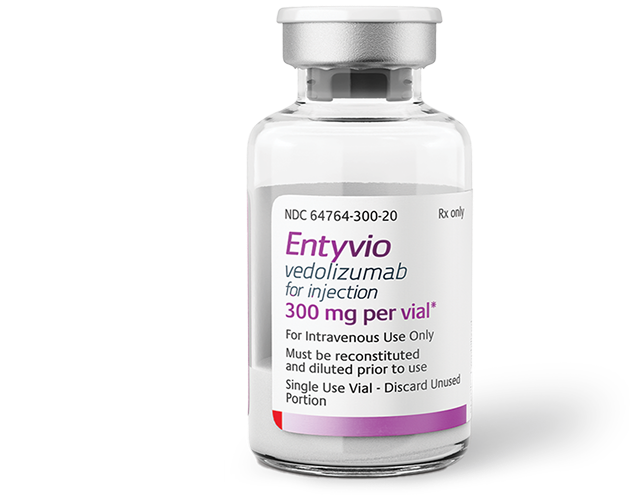
ENTYVIO offers consistent and predictable IV dosing for patients with Crohn's or UC
IV dosing
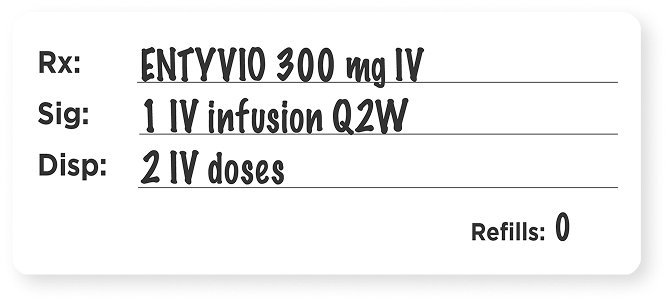
Example prescription of ENTYVIO IV
Start
Start with 300 mg IV infusions for:
Weeks 0 and 21
Maintain
Starting at Week 6, continue with infusions every 8 weeks1
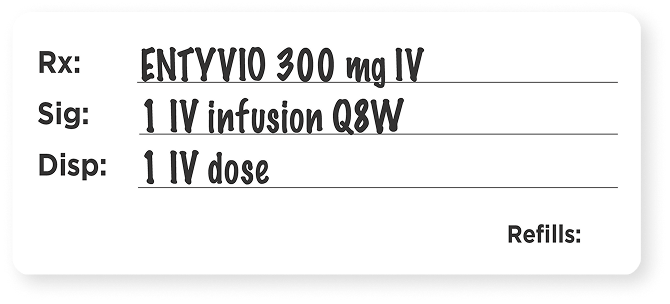
IV=intravenous; Q2W=every 2 weeks; Q8W=every 8 weeks.
Discontinue ENTYVIO in patients who show no evidence of therapeutic benefit by Week 14.1



Prior to administration1
Patients should be brought up to date with all immunizations prior to starting ENTYVIO IV.
Administration1
ENTYVIO is administered as a 300 mg flat dose over an approximately 30-minute IV infusion.
Concomitant therapies1
ENTYVIO IV can be administered concomitantly with aminosalicylates, steroids, or immunomodulators.
Monitoring1
ENTYVIO IV should be administered by a healthcare professional prepared to manage hypersensitivity reactions, including anaphylaxis, if they occur. Appropriate monitoring and medical support measures should be available for immediate use. Observe patients during infusion and until the infusion is complete.
For complete Dosage and Administration information, please see Full Prescribing Information.
Watch the ENTYVIO IV dosing and administration video
ENTYVIO IV Dosing and Administration Instructional Video
For adults with moderately to severely active ulcerative colitis (UC) or Crohn’s disease (CD).
IMPORTANT SAFETY INFORMATION
CONTRAINDICATIONS
ENTYVIO is contraindicated in patients who have had a known serious or severe hypersensitivity reaction to ENTYVIO or any of its excipients.
Please listen for additional Important Safety Information during this video.
The following chapters—reconstitution, dilution, and administration—will explain the steps for the proper use of ENTYVIO intravenous infusion. ENTYVIO should be administered by a healthcare professional prepared to manage hypersensitivity reactions including anaphylaxis. Appropriate monitoring and medical support measures should be available for immediate use. Observe patients during infusion and until the infusion is complete.
Chapter 1: Reconstitution
Remove from 2°C to 8°C (36°F to 46°F) storage and allow vial to equilibrate to room temperature. Remove the flip-off cap from the single-dose vial and wipe with alcohol swab.
Reconstitute ENTYVIO vial containing lyophilized powder with 4.8 mL of Sterile Water for Injection, USP, 0.9% Sodium Chloride Injection, USP, or Lactated Ringer's Injection, USP, at room temperature 20°C to 25°C (68°F to 77°F) using a syringe with a 21- to 25-gauge needle.
Insert the syringe needle into the vial through the center of the stopper and direct the stream of Sterile Water for Injection, USP, 0.9% Sodium Chloride Injection, USP, or Lactated Ringer's Injection, USP, to the glass wall of the vial to avoid excessive foaming.
Gently swirl the vial for at least 15 seconds to dissolve the lyophilized powder. Do not vigorously shake or invert.
Allow the solution to sit for up to 20 minutes at room temperature to allow for reconstitution and for any foam to settle; the vial can be swirled and inspected for dissolution during this time. If not fully dissolved after 20 minutes, allow another 10 minutes for dissolution.
Do not use the vial if the drug product is not dissolved within 30 minutes.
Visually inspect the reconstituted ENTYVIO solution for particulate matter and discoloration prior to dilution. Solution should be clear or opalescent, colorless to light brownish yellow and free of visible particulates. Do not administer reconstituted solution showing uncharacteristic color or containing particulates.
Prior to withdrawing the reconstituted ENTYVIO solution from the vial, gently invert vial three times.
Immediately withdraw 5 mL (300 mg) of reconstituted ENTYVIO solution using a syringe with a 21- to 25-gauge needle. Discard any remaining portion of the reconstituted solution in the vial.
Chapter 2: Dilution
Add the 5 mL (300 mg) of reconstituted ENTYVIO solution to 250 mL of sterile 0.9% Sodium Chloride Injection or sterile Lactated Ringer’s Injection, and gently mix the infusion bag. Do not add other medicinal products to the prepared infusion solution or intravenous infusion set.
Once reconstituted and diluted, use the infusion solution as soon as possible. If necessary, the infusion solution may be stored.
Specific storage conditions and timing for the reconstituted solution in vial and diluted solution in the infusion bag are outlined in Table 1 of the full Prescribing Information.
Do not freeze the reconstituted solution in the vial or the diluted solution in the infusion bag. Discard any unused portion of the infusion solution.
Chapter 3: Administration
Administer ENTYVIO as an intravenous infusion over 30 minutes.
After the infusion is complete, flush with 30 mL of sterile 0.9% Sodium Chloride Injection or sterile Lactated Ringer’s Injection.
The recommended dosage of ENTYVIO in adults with ulcerative colitis or Crohn's disease is 300 mg administered by intravenous infusion. Depending on how maintenance therapy is administered, dosing schedules can vary. For patients on intravenous infusion maintenance therapy, administer ENTYVIO at 0, 2, and 6 weeks, and then every 8 weeks thereafter. For UC patients continuing on subcutaneous maintenance therapy, administer ENTYVIO by intravenous infusion at 0 and 2 weeks before transitioning to subcutaneous ENTYVIO. Please see the dosing and administration section of the full Prescribing Information for more detail.
IMPORTANT SAFETY INFORMATION
CONTRAINDICATIONS
ENTYVIO is contraindicated in patients who have had a known serious or severe hypersensitivity reaction to ENTYVIO or any of its excipients.
WARNINGS AND PRECAUTIONS
- Infusion-Related and Hypersensitivity Reactions: Infusion-related reactions and hypersensitivity reactions, including anaphylaxis, dyspnea, bronchospasm, urticaria, flushing, rash, and increased blood pressure and heart rate, have been reported. These reactions may occur with the first or subsequent infusions and may vary in their time of onset from during infusion or up to several hours post-infusion. If anaphylaxis or other serious infusion-related or hypersensitivity reactions occur, discontinue administration of ENTYVIO immediately and initiate appropriate treatment.
- Infections: ENTYVIO increases the risk for developing infections. Serious infections in clinical trials included anal abscess, sepsis (some fatal), tuberculosis (TB), salmonella sepsis, Listeria meningitis, giardiasis, and cytomegaloviral colitis. Postmarketing reports include systemic bacterial, fungal, viral, and parasitic opportunistic infections.
Do not start ENTYVIO in patients with a clinically important active infection until resolved or adequately treated. In patients with chronic infection or history of recurrent infection, consider risks and benefits prior to ENTYVIO. Instruct patients to seek medical advice if signs or symptoms of acute or chronic infection occur. If a serious infection develops or does not respond to therapy, monitor closely and do not administer ENTYVIO until resolved.
Tuberculosis: Consider evaluating for TB prior to ENTYVIO. Do not administer ENTYVIO to patients with active TB. Before starting ENTYVIO, treat latent TB and consider anti-TB therapy in patients with a history of TB if adequate course of treatment cannot be confirmed. Monitor for active TB during and after ENTYVIO. - Progressive Multifocal Leukoencephalopathy (PML): PML, a rare and often fatal opportunistic infection of the central nervous system (CNS), has been reported with systemic immunosuppressants, including another integrin receptor antagonist. PML typically only occurs in patients who are immunocompromised. One case of PML in an ENTYVIO-treated patient with multiple contributory factors has been reported. Although unlikely, a risk of PML cannot be ruled out. Monitor patients for any new or worsening neurological signs or symptoms that may include progressive weakness on one side of the body or clumsiness of limbs, disturbance of vision, and changes in thinking, memory, and orientation leading to confusion and personality changes. If PML is suspected, withhold dosing with ENTYVIO and refer to neurologist; if confirmed, discontinue ENTYVIO dosing permanently.
- Liver Injury: There have been reports of elevations of transaminase and/or bilirubin in patients receiving ENTYVIO. ENTYVIO should be discontinued in patients with jaundice or other evidence of significant liver injury.
- Immunizations: Prior to initiating treatment with ENTYVIO, all patients should be brought up to date with all immunizations according to current immunization guidelines. Patients receiving ENTYVIO may receive non-live vaccines and may receive live vaccines if the benefits outweigh the risks.
ADVERSE REACTIONS
The most common adverse reactions (incidence ≥3% and ≥1% higher than placebo) were: nasopharyngitis, headache, arthralgia, nausea, pyrexia, upper respiratory tract infection, fatigue, cough, bronchitis, influenza, back pain, rash, pruritus, sinusitis, oropharyngeal pain, pain in extremities, and injection site reactions with subcutaneous administration.
DRUG INTERACTIONS
Because of the potential for increased risk of PML and other infections, avoid the concomitant use of ENTYVIO with natalizumab products and with TNF blockers. Upon initiation or discontinuation of ENTYVIO in patients treated with CYP450 substrates, monitor drug concentrations or other therapeutic parameters, and adjust the dosage of the CYP substrate as needed.
INDICATIONS
ENTYVIO is indicated in adults for the treatment of:
- moderately to severely active ulcerative colitis (UC)
- moderately to severely active Crohn's disease (CD)
DOSAGE FORMS & STRENGTHS
- ENTYVIO Intravenous (IV) Infusion: 300 mg vedolizumab
- ENTYVIO Subcutaneous (SC) Injection: 108 mg vedolizumab
Please see Full Prescribing Information at ENTYVIO.com/PI.
Explore more topics

Explore ENTYVIO Pen dosing

Is ENTYVIO IV right for your patient?
EntyvioConnect offers benefits verification, one-on-one nurse support, and co-pay savings* for patients prescribed ENTYVIO IV.
Please note that our nurses do not provide medical advice. *Must meet eligibility requirements. Terms and conditions apply to co-pay savings program.
The content on this page has been written and reviewed by Takeda.
Reference:
- ENTYVIO (vedolizumab) prescribing information. Takeda Pharmaceuticals.