
For adults with moderately to severely active ulcerative colitis (UC) or Crohn’s disease (CD).

*Quarterly analysis of IQVIA medical and pharmacy claims data from January 2023 through December 2025.

Pen dosing and administration
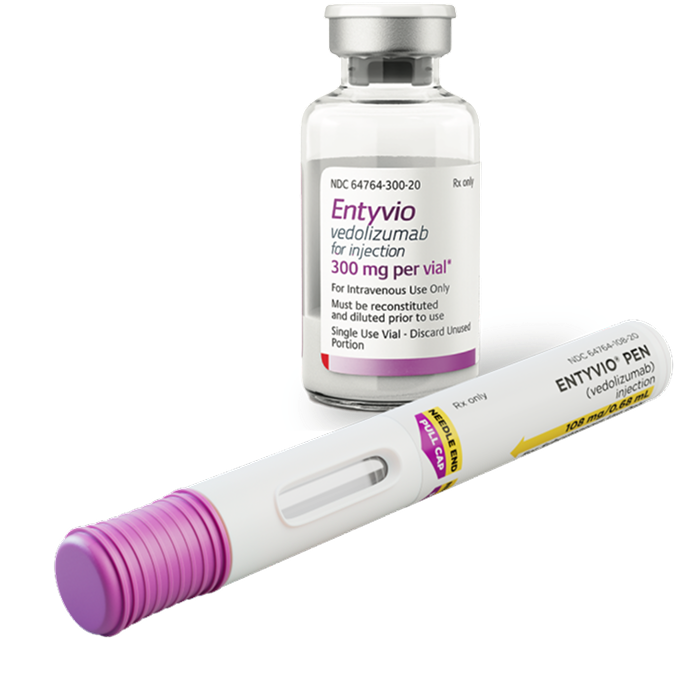
Initiate with IV infusion, maintain with the ENTYVIO Pen
Pen dosing
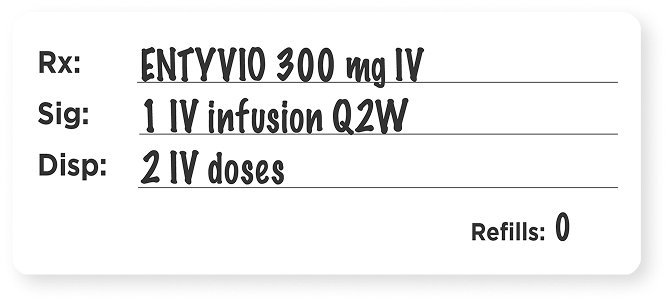
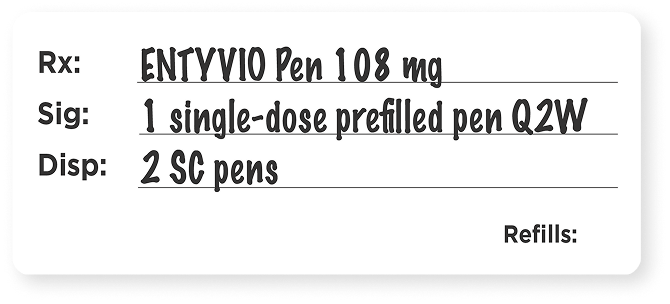
Example prescription of ENTYVIO Pen
Start
Start with 300 mg IV infusions for:
Weeks 0 and 21
Maintain
Starting at Week 6, begin ENTYVIO 108 mg SC and continue every 2 weeks1
To transition patients to ENTYVIO SC, start the pharmacy benefit PA process 2-4 weeks before the next scheduled infusion date.
IV=intravenous; PA=prior authorization; Q2W=every 2 weeks; SC=subcutaneous.
When to switch patients to the ENTYVIO Pen
Patients responding to ENTYVIO IV after Week 6 may be switched to ENTYVIO SC. Administer the first SC dose in place of the next scheduled IV infusion and Q2W thereafter.
The efficacy and safety of switching from ENTYVIO SC to ENTYVIO IV have not been studied.
Discontinue ENTYVIO in patients who show no evidence of therapeutic benefit by Week 14.1
For complete Dosage and Administration information, please see Full Prescribing Information.
Prior to administration1
Patients should be brought up to date with all immunizations prior to starting ENTYVIO SC.
Administration1
ENTYVIO SC is administered in a 108 mg single-dose prefilled pen.
Concomitant therapies1
ENTYVIO SC can be administered concomitantly with aminosalicylates, steroids, and immunomodulators.
Injection education1
After proper training on correct subcutaneous injection technique, a patient or caregiver may administer the ENTYVIO Pen if a healthcare professional determines it is appropriate. Patients and caregivers should be instructed to follow the directions for administration of the ENTYVIO Pen in the Instructions For Use section of the Full Prescribing Information.
Watch the ENTYVIO Pen dosing and administration video
ENTYVIO Dosing and Administration Subcutaneous Injection Instructional Video
For adults with moderately to severely active ulcerative colitis (UC) or Crohn's disease (CD).
IMPORTANT SAFETY INFORMATION
CONTRAINDICATIONS
ENTYVIO is contraindicated in patients who have had a known serious or severe hypersensitivity reaction to ENTYVIO or any of its excipients.
Please listen for additional Important Safety Information during this video.
JEN: Hi, I’m Jen, an advanced practice provider. I assist patients with certain medications and today I'm here with Sam, one of my patients. We’ll be talking about the ENTYVIO pen and its instructions for use. It is designed to deliver an accurate, premeasured dose of medication. I’ll explain each step in 3 chapters, including gathering supplies for ENTYVIO, preparing to inject ENTYVIO, and injecting ENTYVIO.
Ok, are you ready to get started?
SAM: I sure am.
JEN: Great.
JEN: Let’s get started by getting supplies ready for your patient. First, you’ll want to take ENTYVIO from the fridge. Remember, you want to keep ENTYVIO refrigerated between 36°F and 46°F.
You’ll want to check the box to make sure none of the seals are broken. Do not use the pen if any of the seals on the box are broken.
SAM: OK, but what if it’s expired?
JEN: Yes, check that too. Do not use the pen if it is past the expiration date on the box or if it has been frozen.
Now, wait 30 minutes and let your pen come to room temperature.
Remember Sam, do not warm the pen in any other way or place it in direct sunlight. And keep the pen in its tray until you’re ready to inject.
SAM: OK, got it.
So should we prepare my supplies?
JEN: Yes, let’s get started.
SAM: OK.
JEN: We’ve placed all of our supplies on a flat, clean surface before the injection.
We’ve got alcohol pads, cotton balls...
SAM: Would gauze work as well?
JEN: Yes, gauze also works if you don’t have a cotton ball. And you’ll also need a sharps disposal container.
Now we can prepare your patient to inject ENTYVIO. Whenever you inject ENTYVIO, you want to make sure to wash your hands thoroughly with soap and water.
Next, we’ll open the box and remove the pen and tray. Now we can peel the paper from the tray and lift the pen straight out. Remember, do not shake the pen, and do not remove the purple cap until you're ready to inject.
Inspect the pen. Just like checking the box, you will also want to double-check the expiration date on the pen hasn’t passed.
SAM: It looks good, it’s not past the expiration date.
JEN: Great. Now, let’s take a look at the medication window. Do you see any cloudiness or particles?
SAM: No, I don’t.
JEN: Excellent. Do not use the pen if the medicine is cloudy or has particles floating in it.
Now we’ll choose an injection site. You have a few options, but the front of the thighs or stomach areas are ideal. With a caregiver like me helping, you can also consider using the back of the upper arms. When injecting into the stomach, remember to avoid the area about 2 inches around your belly button.
SAM: What about injecting into the same spot twice in a row?
JEN: Good question. Do not inject into the same spot you used for your last injection. You want to rotate injection sites as often as you can. Also do not inject into moles, scars, bruises, or skin that is tender, hard, red, or damaged.
Now you’ll want to use the alcohol pad you gathered earlier to clean the injection site. Make sure to let your skin dry, and do not touch or blow on the cleaned injection site before injection. And now it’s time to inject ENTYVIO.
When you are ready to inject, remove the purple cap from the ENTYVIO pen and throw it away in the sharps container.
SAM: Where’s the needle?
JEN: The needle is in the yellow needle shield.
Remember, do not put or press your thumb, fingers, or hand over the yellow needle shield. And, do not put the purple cap back on the pen because this could accidentally start the injection.
SAM: Got it.
JEN: Now hold the pen so that you can see the viewing window. Next place the yellow part of the pen flat on your skin at 90 degrees to the injection site. Remember, the needle is in the yellow needle shield so do not push down on the pen until you are ready to inject.
SAM: OK.
JEN: Now we’re going to start injecting ENTYVIO. Push the pen straight down and hold for at least 10 seconds. You may hear a first click when the injection starts. You may also hear a second click. But this is not the end of the injection. Continue to hold the pen with constant pressure until the viewing window fills with purple to make sure that you have received your full dose.
Lift the pen from your skin and the yellow needle shield will drop down and lock over the needle. The injection is now complete. However, when you lift the pen from the skin, you will see a small amount of gray in the viewing window. This is normal. But if you do not see the viewing window fill with purple, or if you look and the medicine is still coming out of the pen, this means you have not received your full dose. Call your pharmacy or healthcare provider right away.
SAM: OK.
JEN: And we’re all set. Great job, Sam. We’ve completed your injection of ENTYVIO. You may see a small amount of blood at the injection site. If you do, just press your skin with a cotton ball or gauze.
Now it’s time to throw away the ENTYVIO pen. Many specialty pharmacies have programs that can give patients FDA-cleared sharps disposal containers. When you’re done with your pens, drop them in the FDA-cleared sharps disposal container right away after use.
SAM: Can’t I just throw it in my regular trash bin?
JEN: No, do not recycle it or throw away the pen in your household trash. Always use an FDA-cleared sharps disposal container.
SAM: But what if I don’t have one?
JEN: You can use anything made of heavy-duty plastic that can be closed with a tight seal.
It should also have a puncture-resistant lid that can prevent sharps from coming out. It should be stable and leak resistant. Label it with a warning of hazardous waste inside. You can use an empty laundry detergent container or something similar.
SAM: OK. I like that option.
JEN: Do you have any additional questions for me, Sam?
SAM: What happens if I plan on traveling?
JEN: Actually, your pen can be left in its box at room temperature for up to 7 days. So, you can travel with it.
SAM: Oh, wow. That’s good to know. Okay, I think I am all set.
JEN: Great. Now you know how to inject ENTYVIO and you are fully prepared for your next dose.
IMPORTANT SAFETY INFORMATION
CONTRAINDICATIONS
ENTYVIO is contraindicated in patients who have had a known serious or severe hypersensitivity reaction to ENTYVIO or any of its excipients.
WARNINGS AND PRECAUTIONS
- Infusion-Related and Hypersensitivity Reactions: Infusion-related reactions and hypersensitivity reactions, including anaphylaxis, dyspnea, bronchospasm, urticaria, flushing, rash, and increased blood pressure and heart rate, have been reported. These reactions may occur with the first or subsequent infusions and may vary in their time of onset from during infusion or up to several hours post-infusion. If anaphylaxis or other serious infusion-related or hypersensitivity reactions occur, discontinue administration of ENTYVIO immediately and initiate appropriate treatment.
- Infections: ENTYVIO increases the risk for developing infections. Serious infections in clinical trials included anal abscess, sepsis (some fatal), tuberculosis (TB), salmonella sepsis, Listeria meningitis, giardiasis, and cytomegaloviral colitis. Postmarketing reports include systemic bacterial, fungal, viral, and parasitic opportunistic infections.
Do not start ENTYVIO in patients with a clinically important active infection until resolved or adequately treated. In patients with chronic infection or history of recurrent infection, consider risks and benefits prior to ENTYVIO. Instruct patients to seek medical advice if signs or symptoms of acute or chronic infection occur. If a serious infection develops or does not respond to therapy, monitor closely and do not administer ENTYVIO until resolved.
Tuberculosis: Consider evaluating for TB prior to ENTYVIO. Do not administer ENTYVIO to patients with active TB. Before starting ENTYVIO, treat latent TB and consider anti-TB therapy in patients with a history of TB if adequate course of treatment cannot be confirmed. Monitor for active TB during and after ENTYVIO. - Progressive Multifocal Leukoencephalopathy (PML): PML, a rare and often fatal opportunistic infection of the central nervous system (CNS), has been reported with systemic immunosuppressants, including another integrin receptor antagonist. PML typically only occurs in patients who are immunocompromised. One case of PML in an ENTYVIO-treated patient with multiple contributory factors has been reported. Although unlikely, a risk of PML cannot be ruled out. Monitor patients for any new or worsening neurological signs or symptoms that may include progressive weakness on one side of the body or clumsiness of limbs, disturbance of vision, and changes in thinking, memory, and orientation leading to confusion and personality changes. If PML is suspected, withhold dosing with ENTYVIO and refer to neurologist; if confirmed, discontinue ENTYVIO dosing permanently.
- Liver Injury: There have been reports of elevations of transaminase and/or bilirubin in patients receiving ENTYVIO. ENTYVIO should be discontinued in patients with jaundice or other evidence of significant liver injury.
- Immunizations: Prior to initiating treatment with ENTYVIO, all patients should be brought up to date with all immunizations according to current immunization guidelines. Patients receiving ENTYVIO may receive non-live vaccines and may receive live vaccines if the benefits outweigh the risks.
ADVERSE REACTIONS
The most common adverse reactions (incidence ≥3% and ≥1% higher than placebo) were: nasopharyngitis, headache, arthralgia, nausea, pyrexia, upper respiratory tract infection, fatigue, cough, bronchitis, influenza, back pain, rash, pruritus, sinusitis, oropharyngeal pain, pain in extremities, and injection site reactions with subcutaneous administration.
DRUG INTERACTIONS
Because of the potential for increased risk of PML and other infections, avoid the concomitant use of ENTYVIO with natalizumab products and with TNF blockers. Upon initiation or discontinuation of ENTYVIO in patients treated with CYP450 substrates, monitor drug concentrations or other therapeutic parameters, and adjust the dosage of the CYP substrate as needed.
INDICATIONS
ENTYVIO is indicated in adults for the treatment of:
- moderately to severely active ulcerative colitis (UC)
- moderately to severely active Crohn's disease (CD)
DOSAGE FORMS & STRENGTHS
- ENTYVIO Intravenous (IV) Infusion: 300 mg vedolizumab
- ENTYVIO Subcutaneous (SC) Injection: 108 mg vedolizumab
Please see Full Prescribing Information at ENTYVIO.com/PI.
Ready to prescribe the ENTYVIO Pen for your patients?
The ENTYVIO Pen is available through our Current Distribution Network of specialty pharmacies. To learn more about current participating national specialty pharmacies, download the Specialty Pharmacy Information resource below.
Explore more topics

Explore IV dosing for ENTYVIO

Is the ENTYVIO Pen right for your patient?
EntyvioConnect offers benefits verification, one-on-one nurse support, and co-pay savings for patients prescribed the ENTYVIO Pen.
Please note that our nurses do not provide medical advice. *Must meet eligibility requirements. Terms and conditions apply to co-pay savings program.
The content on this page has been written and reviewed by Takeda.
Reference:
- ENTYVIO (vedolizumab) prescribing information. Takeda Pharmaceuticals.